Best E-Bike Lights: 7 Picks for Riding After Dark
If you want one answer: the NiteRider Lumina Pro 1300 and Omega 330 EVO set. It is the only option here that publishes a run time for every single mode, the two lights switch on together over a wireless link, and 1300 lumens is enough to ride unlit roads at e-bike speeds rather than merely be seen on lit ones.
An e-bike changes what you need from a light. You are covering ground at 20 to 28mph rather than 12, so the beam has to throw far enough that you can still stop inside it. You are in traffic for longer at road speed, which makes a daytime flash mode worth more than it is on a bicycle. And if your bike runs integrated lights off the main battery, a flat battery leaves you with no lights at all, which is its own argument for carrying a second one.
abouteBikes is reader-supported. We research products from their published specifications and owner feedback rather than testing them ourselves, and the links on this page are affiliate links. As an Amazon Associate we earn from qualifying purchases, at no extra cost to you. How we choose what to feature.
Best for what
| Best overall set | NiteRider Lumina Pro 1300 + Omega 330 EVO | See on Amazon |
| Best front light alone | Cygolite Metro 1100 | See on Amazon |
| Best rear light | Cygolite Hotshot Pro 200 | See on Amazon |
| Best for awareness | Garmin Varia RearVue 820 | See on Amazon |
| Best on a budget | Ascher Bike Light Set | See on Amazon |
| Best backup light | Cygolite Dice HL 150 | See on Amazon |
| Best without charging | NiteRider Mako 250 | See on Amazon |
Most lumen figures on Amazon are fiction
Search for a bike light and you will be offered “6800 lumens” and “10000 lumens” for the price of a pizza. Those numbers are not real. A genuine 1000-lumen bike light needs meaningful heat management and a battery to match; a serious commuter light sits somewhere between 150 and 1500 lumens, and the brands that make them do not need to claim otherwise.
There is a simple test that separates the two. A brand telling the truth publishes a run time for each output level. NiteRider states that its Lumina Pro 1300 runs 30 minutes at 1300 lumens, an hour and a half at 800, and six hours at 200. That is a manufacturer being honest about physics. A listing that gives one enormous headline number and a single vague “long-lasting” run time is telling you nothing at all.
The second thing no listing mentions: lumens measure output, not where it goes. A powerful light with a round beam throws as much into oncoming drivers’ eyes and the sky as onto the road. Germany’s StVZO standard requires a shaped cutoff to prevent exactly that, and it is why German-market lights often look dim on paper while lighting the road better. There is no US equivalent, so beam shape is left to you to judge, and none of the listings below describe it.
The seven
01
Best overall set
NiteRider Lumina Pro 1300 + Omega 330 EVO
A matched front and rear pair that talk to each other. NiteLink pairs them wirelessly so one button turns both on. More importantly, this is the only listing here that tells you what you actually get at every brightness setting instead of quoting a headline number and hoping.
Front
1300 lm
Rear
330 lm
Sealing
IP64
Weight
79g each
Key features
- NiteLink wireless pairing, so the rear light follows the front
- Eight front modes, run times published for every one
- Rear runs 36.5 hours on low steady, 6 hours on max flash
- USB-C charging on both units
- Walk mode gives 18 hours at 50 lumens
What stands out
- Honest, mode-by-mode run times, rare enough to be the reason it wins
- USB-C rather than micro-USB, so one cable for everything
- 330 lumens at the back is genuinely bright for daytime use
What to watch
- Thirty minutes at full 1300 lumens. Treat boost as a burst, not a setting
- IP64 is splash-resistant, not rainproof in the way IP67 is
- The most expensive option here by some margin
02
Best front light alone
Cygolite Metro 1100
If your bike already has a decent rear light and you only need to fix the front, this is the one. IP67 sealing is the best on this list (properly waterproof rather than splash-resistant), and SteadyPulse is a genuinely clever idea: a constant beam to see by with pulses overlaid to catch drivers’ attention.
Output
1100 lm
Modes
9
Sealing
IP67
Weight
150g
Key features
- IP67 rated, the only fully waterproof light here
- SteadyPulse overlays alerting pulses on a steady beam
- DayLightning flash mode for daytime road use
- Hard handlebar mount rather than a rubber strap
- Lock mode prevents it switching on in a bag
What stands out
- Waterproofing a step above everything else on this page
- Hard mount does not sag over potholes the way straps do
- Walking mode doubles it as a flashlight
What to watch
- Run times are shown only in a listing photo, not written out
- Twice the weight of the Dice for one bar position
- Front light only, so you still need a rear
03
Best rear light
Cygolite Hotshot Pro 200
Two hundred lumens is a lot for a tail light, and the run-time spread is extraordinary: 2 hours at the brightest setting, 210 hours at the most frugal. For a commuter that means charging it roughly never, provided you pick a sensible mode.
Output
200 lm
Modes
6
Run time
2–210 h
Weight
75g
Key features
- User-adjustable flash speeds, which almost nothing else offers
- Published run time for all six modes
- SteadyPulse helps drivers judge your distance at night
- Seatpost and seat-stay hard mounts included
What stands out
- 210 hours on low steady is close to fit-and-forget
- Bright enough to be worth running in daylight
- Adjustable flash rate lets you tune it to your road
What to watch
- IP64 only: fine in rain, not for jet washing
- Listing covers both 200 and 150 lumen versions; check which you are buying
- Hard mount needs a round seatpost. Aero posts need the flexible version
04
Best for awareness
Garmin Varia RearVue 820
This is a tail light with radar in it. It detects vehicles approaching from behind and warns you on a bike computer, watch or phone before you hear them, and it flashes a brake pattern when you slow. A different category of product from everything else here, and the only one that tells you something rather than just showing you.
Type
Radar + light
Visible
1.24 mi
Battery
24 h flash
Extra
Brake light
Key features
- Radar alerts for approaching vehicles, graded by size and threat level
- Same-speed tracking keeps flagging a car sitting behind you
- Brake light flash pattern when you slow or stop
- Works with a Garmin Edge, a Garmin watch, or the Varia phone app
- 30 hours in radar-only mode
What stands out
- Warns you about traffic an e-bike’s motor noise can mask
- The brake light is the genuinely new idea here
- Phone app means no bike computer needed to start
What to watch
- This listing is a third-party bundle with a power bank, not Garmin’s own box
- Far more expensive than any other light here
- Needs a round seatpost or a separate mount for aero shapes
05
Best on a budget
Ascher Bike Light Set
Front and rear for roughly the price of a pizza, and the reason it is here rather than one of the thousand identical listings around it: Ascher publishes real battery capacities and honest run-time ranges instead of inventing a lumen figure. Three hundred lumens is modest, and it is a real three hundred.
Output
300 lm
Modes
4
Sealing
IPX4
Weight
3.5 oz pair
Key features
- 2000mAh front battery, quoted at 5 to 12 hours by mode
- 330mAh rear, quoted at 9 to 16 hours
- Front rotates 360 degrees on the mount, rear tilts 45
- Silicone strap mounts, no tools, moves between bikes in seconds
What stands out
- Honest specification in a category full of invented numbers
- Strap mounts fit almost any bar or post
- Cheap enough to own a spare set
What to watch
- 300 lumens is for being seen on lit roads, not for lighting unlit ones
- IPX4 is the weakest sealing here
- Owners report the silicone straps as the first thing to perish
06
Best backup light
Cygolite Dice HL 150
One cubic inch and thirty grams. Not the light you ride unlit lanes with, but the light that lives in your bag so that a flat main battery or a forgotten charge never leaves you riding home invisible. On an e-bike with integrated lights, that scenario is the one worth insuring against.
Output
150 lm
Modes
8
Size
1 cu in
Weight
30g
Key features
- Eight modes despite the size, including two daytime flashes
- Same SteadyPulse and DayLightning modes as the Metro
- IP64 water resistant
- Flexible mount fits aero bars where hard mounts will not
What stands out
- Light enough to carry permanently and forget about
- Daytime flash modes make it useful year-round, not just as a spare
- Fits bar space where a full-size light will not
What to watch
- 150 lumens will not light an unlit road at e-bike speed
- Small battery, so boost mode does not last
- Easy to lose precisely because it is tiny
07
Best without charging
NiteRider Mako 250
The only light here that runs on AA batteries, and that is the entire point of it. No charge cycle to forget, no dead lithium cell after three winters, and a flat set fixed by a corner shop rather than a USB port. For a bike that sits unused for weeks at a time, that reliability beats lumens.
Output
250 lm
Power
AA cells
Modes
3
Weight
6.2 oz
Key features
- Replaceable AA batteries rather than a sealed pack
- Two steady modes plus a daylight flash
- Strap mount with a quick-release tab
- 250 lumens, honestly stated
What stands out
- Nothing to charge, ever. Carry spares and it cannot strand you
- No lithium pack to degrade over years of storage
- Quick-release strap moves between bikes instantly
What to watch
- Only two steady modes and one flash, the least flexible here
- Run time is not published anywhere on the listing
- Buying disposable AAs adds up and is worse environmentally
All seven, side by side
| Light | Best for | Output | Sealing | Weight |
|---|---|---|---|---|
| NiteRider Lumina Pro 1300 + Omega 330 | Best overall set | 1300 / 330 lm | IP64 | 79g each |
| Cygolite Metro 1100 | Best front alone | 1100 lm | IP67 | 150g |
| Cygolite Hotshot Pro 200 | Best rear | 200 lm | IP64 | 75g |
| Garmin Varia RearVue 820 | Best for awareness | Radar + light | Not stated | Not stated |
| Ascher Light Set | Best on a budget | 300 lm | IPX4 | 3.5 oz pair |
| Cygolite Dice HL 150 | Best backup | 150 lm | IP64 | 30g |
| NiteRider Mako 250 | Best without charging | 250 lm | Not stated | 6.2 oz |
Four things worth knowing before you fit any of these
Run a light in daylight
Daytime running modes exist because a flashing light makes you visible to a driver pulling out of a side road long before your outline does. Every light here except the Ascher has one. On an e-bike, where you arrive at junctions faster than a driver expects a cyclist to, it matters more than it does on a bicycle.
Aim the front light down
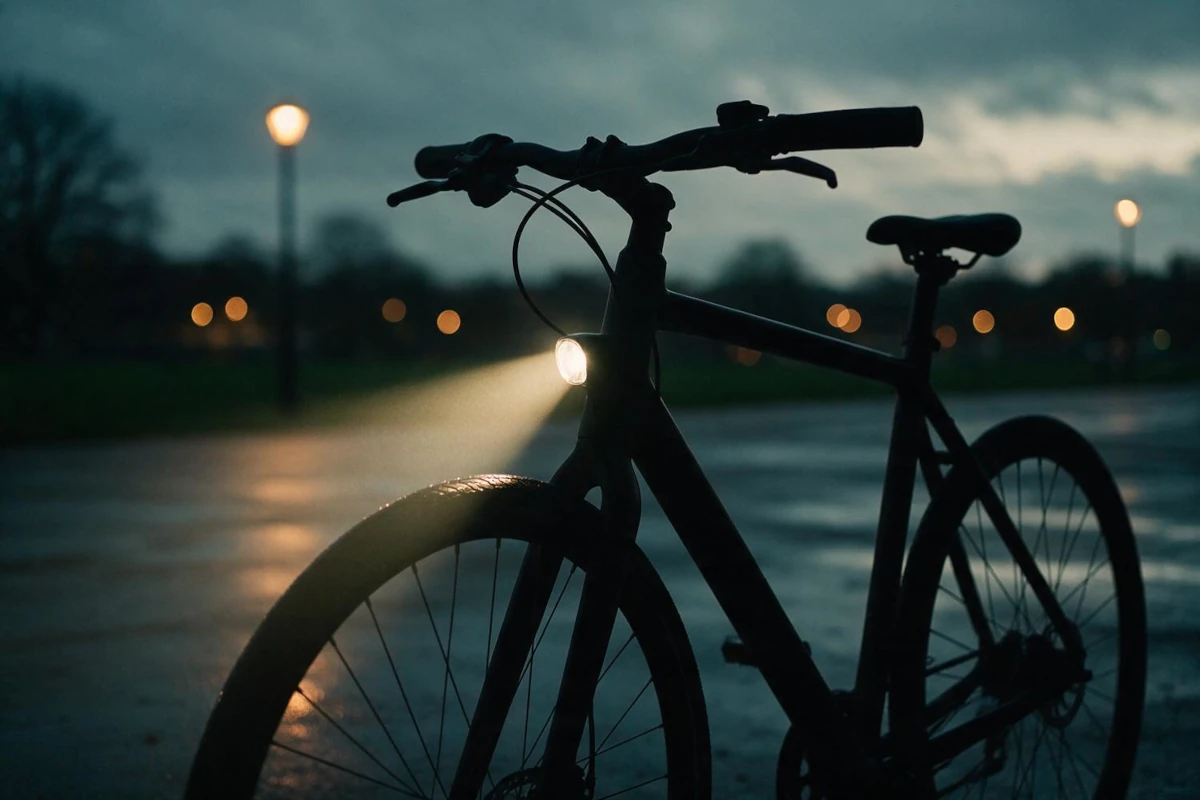
Because none of these have a shaped beam cutoff, a 1100-lumen light pointed straight ahead dazzles everyone coming towards you and wastes most of its output above the road. Angle it so the bright part lands 30 to 50 feet in front of your wheel. You will see the surface better and stop blinding people.
Integrated lights are not enough on their own
If your e-bike has lights wired to the main battery, they are convenient and they fail exactly when the battery does. They are also usually chosen to meet a price rather than to light a road. Treat them as your daytime visibility and carry a real front light for the dark. The Dice exists for this job.
You are invisible from the side
Front and rear lights do nothing for a driver approaching at ninety degrees, which is the geometry of most urban junction collisions. Spoke reflectors, reflective sidewall tires or a reflective ankle band cost very little and cover the angle every light on this page ignores.
The bottom line
Buy the NiteRider set if you ride in the dark regularly and want it settled in one purchase. Buy the Metro 1100 and the Hotshot Pro separately if you want the best of each and do not mind two charging cables. Buy the Ascher set if your roads are lit and you just need to be seen. It is honest about what it is, which is more than most of its competition manages.
Whatever you choose, add the Dice to the bag. The light that matters is the one you have with you. And if you have just bought the bike, our e-bike roundup and lock guide cover the other two decisions.
How we choose
We don’t ride every product on this site. What we do is read the specification properly (output, sealing rating, run time at each setting, mount type) and set it against what owners consistently say once the thing has been in use for a while. Where a claim looks optimistic, we say so.
That means these pages are a shortcut through the spec sheets, not a substitute for trying something. Buy from somewhere with a returns policy, and use it.