Carrying Kids on an E-Bike: An Age-by-Age Guide
Each stage of carrying a child on a bike lasts a couple of years, and each one ends on a weight limit rather than a birthday. Knowing what comes next saves you buying the wrong carrier twice.
This guide runs from the first ride to the point where they ride beside you. Our child seats and trailers roundup compares the specific products. This page is about which kind to buy, and when.
There’s one product link on this page, plus links to our own guides. abouteBikes is funded by affiliate commission. As an Amazon Associate we earn from qualifying purchases, at no extra cost to you. How we make money.
Just want a seat or trailer? See our 7 picks →
The rule that applies at every age
Slow down when a child is aboard. Burley tests its child trailers to 15 mph. Every class of e-bike assists to at least 20. Child seats have no US standard at all, and neither the seat makers nor the trailer makers designed their products around a bike that pulls away like yours does.
Use a low assist level as your speed limiter, keep it under 15 with a trailer, and give yourself far more room to stop. A child and a seat can add 50 pounds to an already heavy bike.
Under 12 months: wait
The American Academy of Pediatrics puts the floor at 12 months. The birthday itself matters less than two things: the child can sit up unsupported, and their neck is strong enough to hold up a helmet. Some seats are sold from 9 months with a note to check with a pediatrician. If you’re near that line, that’s a conversation for your doctor, not a website.
About 1 to 3 years: front seat, rear seat or trailer
This is where most families start, and there are three routes.
A front seat puts the child between your arms, where you can see them and talk to them, and the weight sits between the wheels rather than hanging off the back. For a nervous toddler, being able to see you makes a real difference. The catch is that front seats are outgrown early. They’re typically rated to around 33 pounds (15 kg), which many children pass before they’re three. The Thule Yepp Nexxt 2 Mini is our pick, but check your cockpit has room, because e-bike handlebars are often crowded with a display and a throttle.
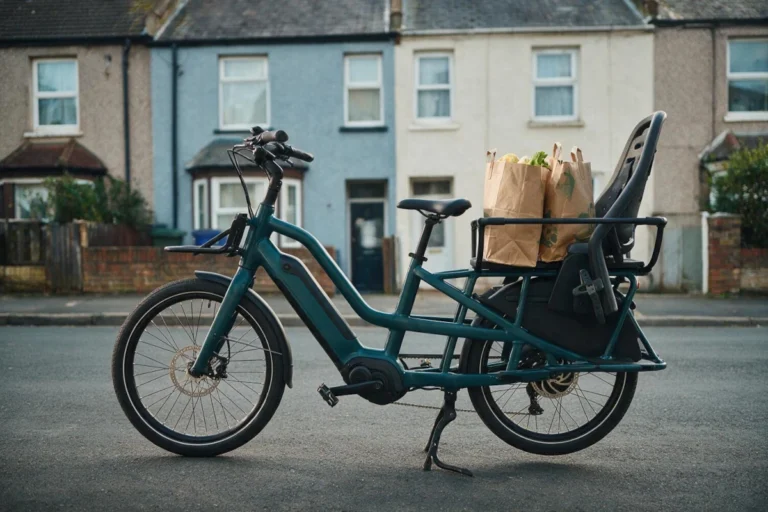
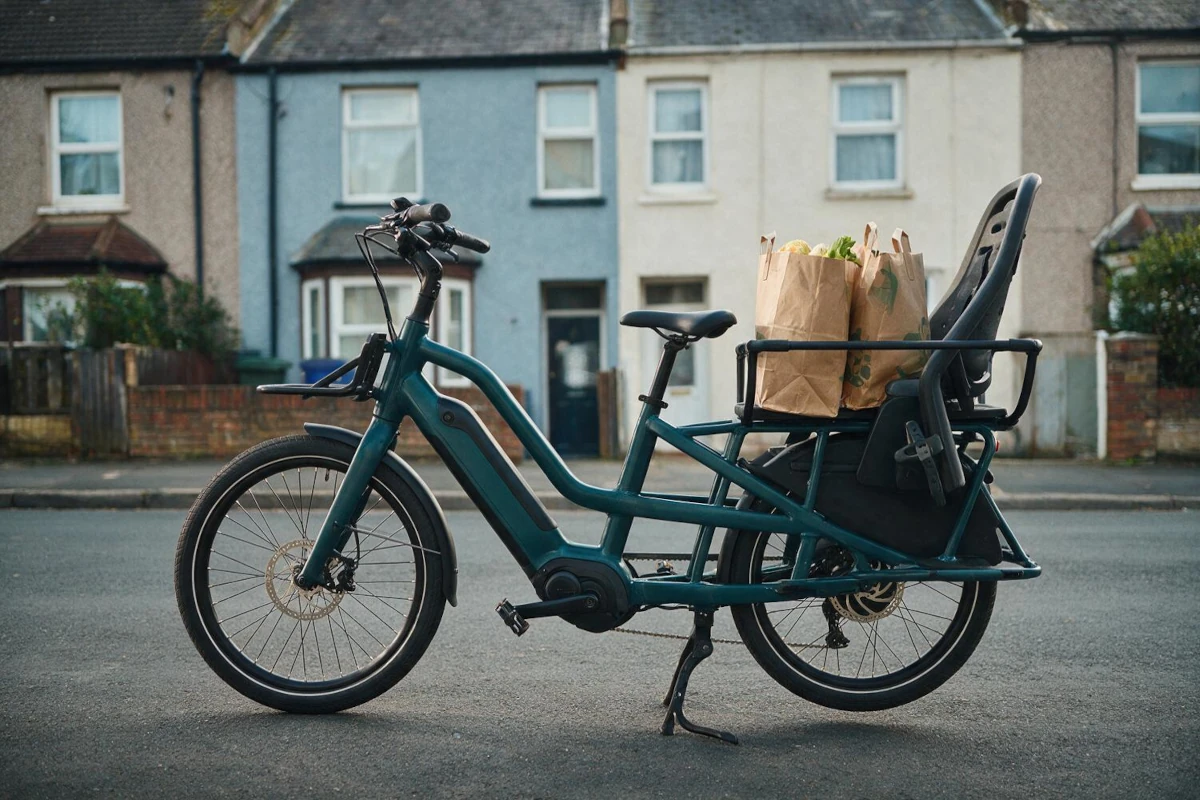
A rear seat lasts longer, commonly up to 40 pounds and around age five. It needs a mount designed for a child. An ordinary luggage rack isn’t one, including the good racks in our racks guide. The Thule Yepp 2 Maxi clicks into a MIK HD carrier built for the job. The Schwinn clamps to the frame instead, if you accept a three-point harness.
A trailer keeps the child low, harnessed, inside a roll cage, and away from the bike if it falls. It takes two children and the shopping, and most convert to a stroller. It’s wide and needs somewhere to live. For most families it’s the safest option, and the Burley Bee is the one to buy.
Aluminum frame, five-point harness, one or two seats, 75 lb capacity, and listed by Burley as e-bike friendly.
About 3 to 5 years: rear seat or trailer
Front seats are behind you by now. A rear seat carries on until the 40-pound limit, and a trailer carries on well beyond it. The Burley Bee takes 75 pounds and the Honey Bee takes 100 across two seats, which is why trailers often end up being the carrier families keep longest.
This is also the age when a child in a rear seat starts to lean, wriggle and grab. You’ll feel all of it through the handlebars. A heavier, lower bike helps, and so does a step-through frame, because you won’t have to swing a leg over a child to get on. Our guide to choosing a frame covers why.
About 4 to 7 years: a trailercycle
There’s an awkward gap between a child too big for a seat and a child ready to ride in traffic. A trailercycle fills it: a half-bike that hitches behind yours, so they pedal and learn to read the road while you steer. The Burley Kazoo takes riders up to 85 pounds.
An e-bike makes this stage easier than it ever was on a bicycle. When small legs give up three miles from home, the motor carries you both. Watch the length, though. You’re towing 55 inches of bike and child, and it swings wide on tight turns.
About 6 and up: riding alongside
At some point they want their own bike. Start on quiet paths, with you riding behind rather than ahead so you can see them. Keep your assist low, because your natural pace on an e-bike is far faster than a seven-year-old’s.
Their own e-bike comes much later. Many states set minimum ages for e-bike riders, commonly 16 for Class 3, and our e-bike classes explainer covers how that varies.
Stages at a glance
| Under 1 | Wait. The AAP floor is 12 months, sitting unsupported and able to hold up a helmet. |
| 1 to 3 | Front seat to about 33 lb, rear seat to about 40 lb, or a trailer. |
| 3 to 5 | Rear seat until 40 lb, or a trailer, which carries on to 75 or 100 lb. |
| 4 to 7 | Trailercycle, up to 85 lb on the Burley Kazoo. |
| 6 and up | Their own bicycle on quiet routes, with you riding behind. |
Before any of it
- Check your e-bike’s manual. Some manufacturers allow child seats and trailers, some forbid them, and some say nothing. Find out before you buy a carrier.
- Check the rear axle. Trailer hitches usually clamp to it, and on a hub-motor bike it’s already crowded with a motor cable and torque washers. Burley points owners of hub-motor bikes at aftermarket axle adapters.
- Check your state’s law. Rules on carrying passengers vary from state to state, and some restrict passengers on e-bikes specifically.
- Helmets for both of you, including a child in a trailer. Bicycle helmets sold in the US must meet the federal CPSC standard, and children’s sizes are fitted in the same way as adults’. For your own, our helmet guide ranks adult helmets by independent impact testing.
- Practice empty. Load a bag of sand or a backpack of the right weight and ride around an empty parking lot first.
Then sort out the rest of the bike. A flat with a child aboard is a genuinely bad afternoon, so fit puncture-resistant tires, and put proper lights on for the school run in winter.
If you only buy one thing
Buy a trailer. It covers more ages than any seat, carries two children, converts to a stroller, and if the bike goes over it stays upright. Seats make sense for short trips, tight storage and children who want to be up front with you. For most families, though, the trailer is the carrier that’s still in use four years later.
Ready to choose a child seat or trailer?
We’ve compared seven seats and trailers, including which ones are actually rated for e-bike speeds.
How we choose
We don’t test child carriers hands-on. The age and weight ranges here come from manufacturers’ published limits and the American Academy of Pediatrics guidance. The product picks come from our child seats and trailers roundup.
Nothing here replaces the carrier’s fitting instructions, your bike maker’s guidance or your pediatrician’s advice. Read all three.