Best E-Bike Tires and Puncture Protection: 7 Picks Compared
If you want one answer: the Schwalbe Marathon E-Plus. It is the only tire here whose listing plainly states ECE-R75 certification for e-bikes of all classes, it carries Schwalbe’s thickest puncture belt, and its compound was built for the torque and weight a motor puts through a tire rather than adapted from a bicycle.
A puncture on a bicycle is an annoyance. A puncture on an e-bike is a different afternoon. The bike is 20 to 30 pounds heavier, the rear wheel often has a hub motor bolted into it with a power cable running out of the axle, and flipping it upside down in a hedge is not the casual job it used to be. Which is why this page is only half about tires. The other half is about not needing them.
abouteBikes is reader-supported. We research products from their published specifications and owner feedback rather than testing them ourselves, and the links on this page are affiliate links. As an Amazon Associate we earn from qualifying purchases, at no extra cost to you. How we choose what to feature.
Best for what
| Best overall e-bike tire | Schwalbe Marathon E-Plus | See on Amazon |
| Best size choice | Continental Contact Plus | See on Amazon |
| Best for pavement commuting | Schwalbe Marathon Plus | See on Amazon |
| Best for fat-tire folders | HEB ALLSCAPE 20×4 | See on Amazon |
| Cheapest upgrade | Rhinodillos tire liners | See on Amazon |
| Best set-and-forget fix | Slime tube sealant | See on Amazon |
| Best prevention | Topeak JoeBlow Sport III | See on Amazon |
The marking most “e-bike tire” listings don’t have
Search Amazon for an e-bike tire and almost every result will tell you it is heavy duty, puncture resistant and built for electric bikes. Almost none of them will point at a standard, because there is no American one to point at. Unlike helmets, locks or batteries, e-bike tires have no US certification behind them at all.
Europe does have one, and the good manufacturers sell the same tires here with the marking intact. ECE-R75 is the regulation that certifies a tire for a given speed and load, and tires that meet it are labeled E-25 or E-50, meaning certified to 25 km/h or 50 km/h, roughly 16mph and 31mph. It exists because a motor pushing a heavy bike puts forces through a casing that a bicycle never does, and because in parts of Europe a speed pedelec legally cannot be sold on an uncertified tire.
Here is the honest part, and it is the reason this section is near the top rather than buried. If you ride a Class 1 or Class 2 bike, capped at 20mph, a good ordinary touring tire is almost certainly fine. The marking is not magic and it does not make a tire puncture-proof. It is a load and speed rating, not a protection rating. Where it starts to matter is a Class 3 bike doing 28mph, a cargo bike carrying a child and a week’s shopping, or a heavy fat-tire machine. Those are the cases the certification was written for.
What the marking is genuinely useful for is as a filter. A brand willing to put its tire through R75 testing is a brand that publishes real numbers elsewhere too. A listing that shouts “EXTREME DURABILITY” in capitals and names no standard at all is asking you to take its word for it.
The seven
01
Best overall e-bike tire
Schwalbe Marathon E-Plus
The tire the rest of this list gets measured against. Schwalbe rates its puncture protection at level 7 (the patented SmartGuard belt with two further layers of RaceGuard fabric behind it), and the listing states ECE-R75 certification for e-bikes of all classes, with e-bike use up to 50 km/h. Everything about it is built for a bike with a motor rather than borrowed from one without.
Size
700x45C
Rating
ECE-R75
Protection
Level 7
Compound
ADDIX-E
Key features
- ECE-R75 certified, stated on the listing as ready for e-bikes of all classes
- Rated for e-bike use up to 50 km/h, which covers a Class 3 bike at 28mph
- Smart DualGuard: the SmartGuard belt plus two layers of RaceGuard fabric
- ADDIX-E compound developed specifically for e-bike grip and wear
- Reflective sidewall and twin skin construction, wire bead
What stands out
- The clearest e-bike certification on this page, written on the listing rather than implied
- Level 7 is the thickest protection Schwalbe builds into a touring tire
- Tread depth suits towpaths and hardpack, not just pavement
What to watch
- Heavy, as every level 7 wire-bead tire is, and you will feel it lifting the bike
- Sold singly, so budget for two
- Amazon’s spec box reads “700x545c”; the title’s 700x45C is the real size
02
Best size choice
Continental Contact Plus
The same idea as the Schwalbe, from the other German manufacturer, and the reason it earns its own place is the size list. One listing covers 26×1.75 through 700×42, which matters because a great many US e-bikes (step-throughs, older conversions, anything built on a mountain bike frame) still run 26-inch wheels that most tire makers have quietly stopped supporting.
Sizes
26″ to 700c
Rating
E-50
Protection
SafetyPlus
Sidewall
Reflective
Key features
- E50 marked and described on the listing as R75 certified
- SafetyPlus breaker layer under the tread
- Six sizes on one listing: 26×1.75, 28×1.5, 47-507, 700×32, 700×35 and 700×42
- Reflective sidewall band across the range
- Listing states a lifetime warranty
What stands out
- Covers 26-inch wheels, which rules it in where the Schwalbe rules itself out
- Reflective sidewall covers the angle your front and rear lights don’t
- Continental’s touring casing is a long-known quantity
What to watch
- Some sizes ship from Amazon Germany, and the delivery estimate stretches to weeks
- Price swings widely between sizes on the same listing, so check before you commit
- Wire bead, so it will not fold into a pannier as a spare
03
Best for pavement commuting
Schwalbe Marathon Plus
The tire that built Schwalbe’s reputation, and the one commuters buy when they have simply had enough. Underneath the tread sits a 5mm belt of elastic rubber, the original SmartGuard, which is thick enough that glass and thorns stop being events. At 35mm it is narrower and quicker on pavement than the E-Plus above, and this listing states ECE-R75 and E25/E50 construction.
Size
700x35C
Rating
E-50 stated
Belt
SmartGuard
Casing
67 TPI
Key features
- SmartGuard belt of elastic rubber, the thickest single layer Schwalbe makes
- Listing states ECE-R75 certification for e-bike use up to 50 km/h
- Reflex sidewalls with light-reflecting bands
- 35mm profile rolls noticeably quicker than a 45mm tire on pavement
- Silica-based compound aimed at wear life rather than outright grip
What stands out
- The reference point for “I never want another flat”
- Quicker and lighter than the E-Plus if you never leave pavement
- Sold in E-50 versions, but check the marking on the size you pick
What to watch
- Notoriously hard to fit. The last few inches of bead fight back
- Rides dead compared with a supple tire; that is the trade for the belt
- This listing is 700x35C only, and not every Marathon Plus size carries an E marking
04
Best for fat-tire folders
HEB ALLSCAPE Fat Tire, 20×4
A large share of American e-bikes are 20×4 fat-tire folders, and neither Schwalbe nor Continental really serves that size. This is one of the few listings that does, names e-bikes as the use case, and sells a matched pair rather than a single tire. Be clear about what you are buying, though: every durability claim here is the manufacturer’s own, with no standard behind it.
Sizes
16×4 to 26×4
Sold as
2-pack
Tread
Herringbone
Rating
None stated
Key features
- Sold as a pair, which most fat-tire listings are not
- Directional herringbone tread aimed at pavement with occasional gravel
- Maker describes high-density rubber and extra tread thickness for e-bike loads
- Available in 16×4, 20×3, 20×4, 24×4, 26×3 and 26×4
- US seller with customer service based in California
What stands out
- Fills a size gap the European brands largely ignore
- Road-biased tread is far quieter than the knobbly tires most fat e-bikes ship with
- Priced per pair, so the real cost is lower than it first looks
What to watch
- No ECE-R75, E-25 or E-50 marking stated anywhere on the listing
- No weight, TPI or belt thickness published, so the claims are unverifiable
- “Motorcycle tire technology” is marketing language, not a specification
05
Cheapest upgrade
Rhinodillos Bicycle Tire Liners
A strip of tough polymer that sits between tire and tube. It is the only option here that adds protection to the tires you already own, for a fraction of the cost of replacing them, and it moves to your next set afterwards. The maker claims up to twice the thorn resistance of earlier liners and 10% less weight than a standard Mr. Tuffy.
Type
Tire liner
Sizes
9
Weight
95g per roll
Reusable
Yes
Key features
- Fits between tire and tube, with no new tire and no sealant
- Rounded edges and soft tips, specifically to avoid friction flats
- Quoted at 95g per 26×2 roll, 10% lighter than a standard brown liner
- Nine sizes; this listing covers 26/24 x 1-3/8 and 700c x 38-40
- Moves from bike to bike as tires wear out
What stands out
- By far the cheapest way to add protection without buying tires
- No mess, unlike sealant, and nothing to top up
- Survives the tires it is fitted in, so the cost is spread
What to watch
- Adds rotating weight at the rim, where it costs you most
- A badly fitted liner chafes the tube and causes the flat it was meant to prevent
- Does nothing for a sidewall cut or a pinch flat
- Not worth fitting inside an already-thick tire like the Marathon Plus
06
Best set-and-forget fix
Slime Tube Sealant
Sealant goes inside the tube and stays there, sealing punctures as they happen rather than preventing them. It is the only product on this page that fixes a flat while you keep riding, and on a hub-motor bike that is worth more than it sounds. Slime quotes punctures up to 1/8 inch and up to two years of protection.
Type
Tube sealant
Seals to
3mm
Lasts
Up to 2 yr
Bottle
8 oz
Key features
- Fibro-Seal formula seals tread punctures up to 1/8 inch (3mm)
- Works repeatedly, on new punctures and existing slow leaks
- Quoted at up to two years of continuous protection
- Non-toxic and water soluble, so spills wash off
- For inner tubes only. The maker states it should not be used in tubeless tires
What stands out
- The only thing here that repairs a puncture without you stopping
- Cheap enough to do both wheels and forget about it
- Works in whatever tires are already on the bike
What to watch
- Tread area only: no sidewall cuts, pinch flats or rim-side holes
- Adds weight to each wheel, and it is weight at the rim
- Makes any later tube repair a messy job
- Needs a removable valve core, or a tube sold pre-filled
07
Best prevention
Topeak JoeBlow Sport III
The unglamorous answer. More e-bike flats are caused by low pressure than by anything sharp, because a soft tire lets the rim pinch the tube against every pothole and a heavy bike hits potholes harder. A floor pump with a gauge you can read costs less than one tire and prevents more punctures than any belt.
Max
160 psi
Head
TwinHead DX5
Valves
All three
Gauge
3 in analog
Key features
- Three-inch analog gauge, readable while you are pumping
- TwinHead DX5 takes Presta, Schrader and Dunlop with no parts to swap
- Steel barrel and base rather than plastic
- Long hose, so the pump stays put while you reach the valve
What stands out
- Schrader support matters, because most US e-bikes and every fat tire use it
- A gauge large enough to read is the entire point of owning a floor pump
- Steel construction survives being kicked around a garage for years
What to watch
- 160 psi is far beyond anything a bike tire needs; you live at the bottom of the dial
- High-pressure gauges are least precise at the low end, which is awkward for a fat tire at 15 to 20 psi
- It is a floor pump, so it stays at home; you still want a mini pump on the bike
All seven, side by side
| Product | Best for | Type | E-bike rating | Fits |
|---|---|---|---|---|
| Schwalbe Marathon E-Plus | Best overall | Tire | ECE-R75, to 50 km/h | 700x45C |
| Continental Contact Plus | Best size choice | Tire | E-50 | 26″ to 700c |
| Schwalbe Marathon Plus | Pavement commuting | Tire | E-50 stated | 700x35C |
| HEB ALLSCAPE | Fat-tire folders | Tire, pair | None stated | 16×4 to 26×4 |
| Rhinodillos liners | Cheapest upgrade | Liner | Not applicable | 9 sizes |
| Slime sealant | Set and forget | Sealant | Not applicable | Tubes only |
| Topeak JoeBlow Sport III | Prevention | Floor pump | Not applicable | All valves |
Four things worth knowing before you buy any of these
Pressure is the cheapest protection there is
An e-bike with a rider and a pannier of shopping can weigh 100 pounds more than the bicycle the same tire was designed around. Run it soft and the rim squeezes the tube against the casing every time you hit an edge, which is a pinch flat: two neat slits, nothing sharp involved, entirely preventable. Every tire has its pressure range printed on the sidewall. Check it with a gauge once a week, not with a thumb.
A rear flat on a hub-motor bike is a different job
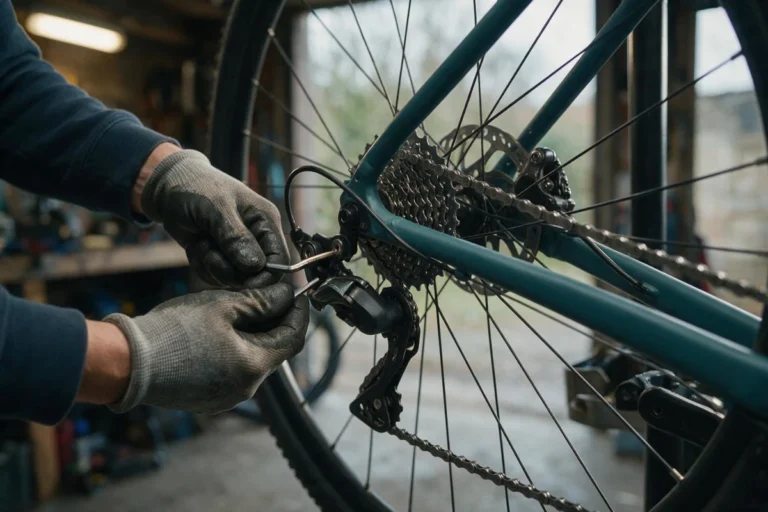
On a bicycle you flip it over and the wheel drops out. On a hub-motor e-bike there is a power cable emerging from the axle, often torque washers or an anti-rotation plate that has to go back in the right orientation, a disc rotor to avoid bending, and a wheel that might weigh 25 pounds on its own. None of it is hard, but it is not a roadside job in the dark. That asymmetry (cheap to prevent, expensive to fix) is the whole argument for spending more on the rear tire than you would on a bicycle.
Stacking protection has diminishing returns
A liner inside a Marathon Plus is a great deal of weight and effort for very little extra protection, and the liner’s edges give you a new way to puncture that you did not have before. Pick one approach per wheel. A thick tire if you are replacing tires anyway; a liner or sealant if you are not. Sealant is the one thing that layers sensibly with anything else, because it works on holes rather than on impacts.
Changing tire width changes more than comfort
Before you order, check three things: that the new width clears your frame and fenders, that your rim is rated for it, and that your bike does not measure speed from a wheel sensor. Many e-bikes do, and a noticeably taller or shorter tire shifts the indicated speed, and therefore where the assist cuts out. On a Class 3 bike that is the difference between a legal 28mph and something else.
The bottom line
If you are replacing tires anyway, buy the Marathon E-Plus for a fast or heavy bike, the Contact Plus if you need a size the E-Plus does not come in, or the Marathon Plus if you commute on pavement and want the lighter, quicker one. Fat-tire folders are stuck with unbranded options, and the HEB ALLSCAPE is the most honest of them about what it is for. Just read its claims as claims.
If your tires are fine and you just want fewer flats, spend a few dollars on sealant and rather more attention on pressure. That combination will do more for you than any tire on this page. And if you are still choosing the bike itself, our e-bike roundup, lights guide and battery explainer cover the rest.
How we choose
We don’t ride every product on this site. What we do is read the specification properly (certification, protection layers, sizes, published weights) and set it against what owners consistently say once the thing has been in use for a while. Where a claim looks like marketing rather than a measurement, we say so.
That means these pages are a shortcut through the spec sheets, not a substitute for trying something. Buy from somewhere with a returns policy, and use it.